
Book Review
In Peacemaking From Above, Peace From Below, Norrin M. Ripsman argues that stable
peace agreements can be achieved through a stepwise theoretical framework (1). In the first step,
peace settlements depend on “top-down” approaches brokered by states, with realist motivations
constraining them to make concessions and agree to the terms of peace negotiations. Then, in the
second step, the agreement’s stability relies on societal buy-in, conforming to liberal and
constructivist theories of “bottom-up” strategies for peacebuilding. While Ripsman advances a
cogent and compelling argument based on the cases he selects, he uses a circumscribed
definition of “regional rivals” to the detriment of his theory. He also does not provide any causal
mechanisms to explain how and why some former rivals can successfully proceed from the first
step to the second step to create long-term peace, while others cannot.
In this paper, I begin with a summary of Ripsman’s book, locating it in the existing scholarly literature of international relations theory.
The next section examines Ripsman’s theory in detail, followed by an examination of his empirical evidence.
The last section proposes a research method to advance Ripsman’s theory by effectively broadening his definition of regional rivals and presenting two critical dimensions of a peace agreement that may explain how and why some treaties are stable, and others are not.
Peacemaking From Above, Peace From Below:
What causes the outbreak of peace in hostile and enduring regional rivalries? Does it
involve negotiations between states or open dialogues between societies? Ripsman argues that
both are necessary and proposes that stable peace agreements are achieved through a sequential
and synthetic theoretical framework. Peace settlements depend on “top-down” approaches
brokered by states, with the constraints of realpolitik forcing them to make concessions and
agree to the terms of peace negotiations. Then, peace is entrenched by society, conforming to
“bottom-up” strategies for peacebuilding. This theory combines three predominant schools of
thought in international relations literature: realism, liberalism, and constructivism.
The “top-down” mechanism, or “transition to peace,” is mostly derived from theories of
structural realism, whereby states are constrained by an inherently anarchical system and can
only depend on themselves for security and survival. These theories disregard the “unit” level
and treat any variation among states as negligible, focusing instead on the distribution of
capabilities across the system as the driving factor influencing international relations (2). Under
these conditions, Ripsman explores four main causal mechanisms for regional peace: 1)
balancing against greater threats, 2) hegemonic or great power influence, 3) reassurance
signaling, and 4) state preservation motives.
Following balance-of-power and balance-of-threat theory, rivals should be willing to
settle their differences when faced with a greater threat (3). This has the strongest effect when both
rivals face a greater common threat. However, when one state alone is faced with a great threat
(or an accumulation of smaller threats), it can also be incentivized to end hostilities and engage
in the peace process. The second mechanism Ripsman discusses, hegemonic stability theory,
assumes that order and peace come from an international concentration of power rather than a
balance of power. When there is one dominant power (or hegemon) in the international system,
that state can use its economic, military, and political power to influence regional rivals with
incentives and disincentives to induce cooperation (4). The third mechanism, reassurance signaling,
occurs when one state, believing its adversary to have benign intentions, sends costly signals to
its rival demonstrating its reciprocal benign intentions (5). Examples of signaling benign intentions
include demilitarizing contested areas or making territorial concessions. Ripsman argues that
states typically send these costly signals when faced with greater threats, so he treats this as a
subclass of the “balancing against greater threats” group and does not test it as a different
explanation. The last “top-down” explanation for ending regional rivalries is not structural, but
rather a neoclassical realist analysis concerning domestic politics. When state leaders feel that
their power or regime is threatened, they may make peace overtures to preserve their power (6).
Walter Lippman and Reinhold Neibuhr argue that the public is more resentful of the
enemy than the state; they posit that the state is too pragmatic to hold grudges and is more likely
than society to pursue peace, even if unpopular (7). Ripsman accepts this premise as true for the
purpose of promoting his theory. His top-down mechanisms all share the core tenet that the
foreign policy executive must be insulated to the maximum extent possible from societal
pressures or other checks and balances. This assumes that state leaders are more susceptible to
these realist constraints and are more willing to make concessions that may be unacceptable to
society. The more autonomy that leaders have, the better the outcome will be for peacemaking.
The “bottom-up” mechanism, or “post-agreement phase,” (which, according to Ripsman,
must follow the top-down stage and optimally become operational only after a peace treaty is
signed) views societies as the “engine of conflict resolution” (pg. 33). These strategies seek to
promote societal interest in irenic cooperation, cultivating societal norms that eschew conflict,
encouraging representative government and institutions, and targeting the root causes of conflict
by addressing ethno-nationalist grievances. Ripsman focuses on four main mechanisms to
achieve bottom-up peace between regional rivals: 1) democratic institutions and norms, 2)
commercial liberalism, 3) institutional norms and identities, and 4) state-to-nation congruence.
Democratic Peace Theory posits that the chances of two states going to war are
dramatically decreased if they are both democracies. Democratic states are less likely to view
using force against regional rivals as legitimate because they recognize the others’ democratic
values and norms as similar to their own (8). Commercial liberalism argues that economic
interdependence fosters stability between states, and constructivist institutionalism postulates
that shared norms and ideas shape societies’ identities (9). Thus, states embedded in cooperative
international institutions shift from a conflict-ridden Hobbesian order to a Lockean or Kantian
order where states are less likely to view one another as enemies because of their shared norms
and values (10). Finally, Benjamin Miller’s state-to-nation balance involves societal incongruence
when a single state contains many nations, or one nation is spread across many states. Miller
suggests that regional peace can be created by making new states for stateless groups or
transferring territory or populations to segregate ethnic groups and make state borders congruent
with nationalistic identity (11).
Ripsman’s theory is an amalgam of these top-down and bottom-up theories. He argues
that peacemaking begins at the level of the state due to imminent threats, great power influence,
and domestic political motives to preserve power. Then, bottom-up strategies like democracy
promotion, correcting the state-to-nation imbalance, fostering economic interdependence, and
joining cooperative regional institutions can entrench peace in societies. To this end, Ripsman
advances existing theories of institutionalism. He asserts that joining international institutions
and tying states together via economic interdependence does not in and of itself cause peace and
cooperation. Instead, adopting collective norms, developing mutually beneficial exchanges, and
increasing trade can be used to solidify peace agreements originally negotiated under the
pressures of an anarchical self-help system where states are bound by the security dilemma.
Ripsman views international organizations’ role as secondary; the influence they exert on the
behavior of warring states only comes into play after a peace treaty has been signed.
To test his theory, Ripsman examines “the universe” of twentieth-century regional
rivalries, selecting on the dependent variable to examine the rivalries that ended in peace treaties,
whether they be stable, enduring, or temporary (pg. 7). “Stable” peace agreements are defined as
those that proceed successfully through both top-down and bottom-up steps. “Enduring” treaties
are those that are only constrained by top-down mechanisms. These enduring treaties remain in
effect, but the peace has never been socially accepted. “Temporary” settlements are made via
short-term statist constraints, and once those pressures dissipate, so does the peace. Ripsman
includes agreements that have lasted for at least ten years, are between roughly equal and
institutionalized states (not civil wars or wars between weak or failed states), and are located in
geographically distinct regions (e.g., Western Europe, the Middle East, Latin America). These
limitations result in only nine rivalries in the twentieth century that terminated with peace
settlements. He selects three treaties to examine in detail (France and Germany in 1954, Egypt
and Israel in 1979, and Israel and Jordan in 1994), followed by brief analyses of the other six
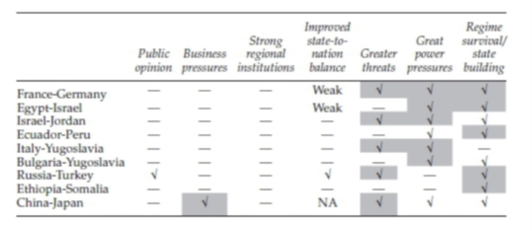
cases. Ripsman determines that top-down mechanisms drove the initial peace settlements (except
for a contribution of domestic pressure in the Sino-Japanese treaty in 1978, where business elites
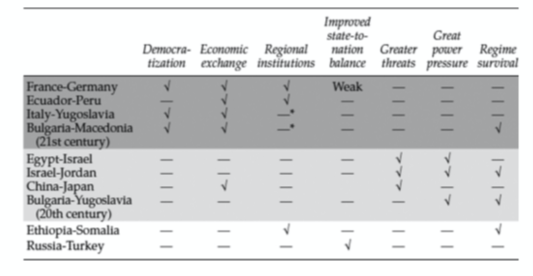
lobbied for peace). In four of the nine cases, bottom-up mechanisms facilitated societal buy-in
after the settlement, creating a stable peace. In three cases, the peace settlement was enduring.
However, only continuing statist constraints keep the peace treaty in place. Finally, in two cases,
peace was only temporary. Once top-down mechanisms disintegrated, so did the peace. Below
are the charts contained in Ripsman’s book which show (1) the cause of the transition to peace
and (2) the development of the post-agreement phase:
Theoretical Analysis:
The framework of Norrin M. Ripsman’s theory is innovative and perceptive in his use of
several theoretical paradigms to explain various stages of peacebuilding and his focus on
regional rivalries. He presents a persuasive argument based on the case studies he selects and
offers many other insights into what makes a peace process succeed. However, his selection of
regional rivalries is too limiting; even though he presents them as “the universe of regional
rivalries,” his universe is carefully circumscribed to exclude many conflicts within the historical
period selected. His two-step chronology also ignores the causal mechanisms for how postconflict
states proceed from the first step to the second. The failure to address these mechanisms
causes Ripsman’s theory to ignore crucial factors that must be present in the first step to allow
the second step to be successful. Finally, Ripsman relies on a priori assumptions about state
leaders and the society they represent, which may or may not be true in every case.
By studying the genesis of peace, Ripsman also creates an eclectic and iterative
framework for the outbreak of war. Hegemonic stability theory posits that anarchy and the
constraints of the security dilemma are the primary cause of war. This theory, elucidated by
Robert Gilpin, proposes that a hegemon can diminish the possibility of war by increasing the
benefits of cooperation and the costs of defection. If this is achieved, peace will follow.
Inversely, liberal institutionalism theory posits that war is caused primarily by greed and
opportunism. Under this theory, war results when rivals expect to gain wealth or territory, and
the costs of war are believed to be acceptable based on the potential material gains. Thus, the
development of economic interdependence and mutually beneficial exchanges can make war less
profitable and, therefore, less likely because trade and beneficial exchanges will be lost.
Ripsman’s central thesis that peacemaking proceeds sequentially has compelling implications for
the outbreak of war. It suggests that war has international structural causes, but repeated war or
hostile war, especially by warring factions in close proximity, creates particularly intense
rivalries. Regional rivalries may lead to the loss of cultural or historically significant territory
and spawn myths and nationalism. This intensifies and entrenches the conflict and extends the
rivalry beyond the systemic conditions that led to war.
While Ripsman’s theory presents a cogent argument about how regional rivals engage in
war and peace, his theory is based on a narrow definition of “regional rivals.” He tests his theory
by limiting when the rivalries occurred, the character of the rivals, and their geographic location.
Limiting his examination to twentieth-century cases makes sense given his data collection
methods (e.g., using the Polity IV index for regime type and using public opinion polls and
interviewing diplomats where possible about peace settlements). However, he undermines his
theory by limiting his definition of regional rivals to well-institutionalized states and excluding
rivalries like Spain and Morocco because they fail to fall under his “regional” definitions (he
considers Spain to be Western Europe and Morocco to be North Africa). Consequentially,
Ripsman’s theory is bolstered by evidence based on only nine rivalries in the twentieth century
that terminated with peace settlements. However, especially since World War II, most wars and
rivalries involve weak states or civil combatants, so excluding them reduces his theory’s
practical value. Scholars like R. Harrison Wagner and David Lake also argue that some analytic
boundaries are irrelevant, and international relations theory can also strengthen and inform
theories concerning intrastate conflict (12). Therefore, while Ripsman’s theory is persuasive given
the cases he examines, it may or may not apply to most regional rivalries (as the term is
understood more broadly).
Another limitation of Ripsman’s theory is that he never addresses any causal mechanisms
for how post-conflict societies proceed from a “top-down” brokered peace settlement to “bottom-up”
strategies for cementing the peace; he merely remarks that both steps one and two must
occur for a peace settlement to be stable. The sequential nature of Ripsman’s theory is what
makes it idiosyncratic but addressing the connection between step one and step two is essential
to understanding how peace agreements become stable. Ripsman also argues that the more
insulated that leaders can be from society as they negotiate and sign an agreement, the better.
However, having an isolated, top-down negotiated settlement that seeks to exclude society to the
maximum extent possible and then relying on society to entrench that peace is a non sequitur,
especially in a theory based primarily on sequence. How can a society buy into a treaty brokered
in secret, with purposeful distance from any societal input? Is he assuming that peace agreements
have a trickle-down effect? What mechanisms allow societies to accept the terms of the
agreement and move towards “bottom-up” peacebuilding?
There are two crucial factors in top-down implemented peace settlements that likely
affect societal buy-in: 1) what type of leaders are at the negotiating table, and 2) what are the
characteristics of the settlement itself? Ripsman does not consider either of these two crucial
factors. Rather, Ripsman writes that he does not “make normative judgments about the contents
of the peace settlement.” Instead, the purpose of his research is to determine what makes peace
possible, “whatever peace terms are negotiated and accepted by the rivals, regardless of whether
these terms are truly fair and just” (pg. 7). While I agree that there should not be judgments about
whether peace terms are “fair” or “just,” there are critical dimensions of peace treaties that
should not be ignored when examining what creates stable peace.
To achieve societal buy-in after a peace settlement, the leaders who broker the settlement
must balance two traits: “legitimacy” and “effectiveness.” Legitimacy is defined as a leader’s
right to govern; they can be democratically elected, but this does not have to be the case. They do
not exploit divisions in society to consolidate their power. At the same time, leaders who
negotiate peace settlements must also be effective. “Effectiveness” is defined as the ability to
maintain power and impose policy choices, even if they are unpopular. The failure to consider
who negotiates a peace treaty on behalf of the people likely misses a major factor in achieving
stable peace.
Another potentially important factor relating to the leaders involved in negotiations and
peace treaty terms is the treatment of corruption, both how it will be identified and what the
consequences will be if it occurs. In eight of the nine cases that Ripsman examines (excluding
the treaty between Italy and Yugoslavia), the “top-down” impetus for negotiating a peace
settlement was to preserve the state or regime, indicating that leaders were attempting to
maintain their power. For this reason, it is critical to prevent leaders from using the peace terms
to entrench their power or to use that power for personal gain to the detriment of society. There
is evidence that post-conflict negotiations that prioritize anticorruption fare better in the long
term than those that do not (13). For “bottom-up” societal buy-in to occur, this is essential. Ripsman
writes:
“To create the conditions for future peacemaking, even if the conditions are not currently
conducive, outside actors should encourage rival states to insulate their executives. It is true that
there are drawbacks of autonomy in terms of the corruption and trampling of accountability that
can result, but if peacemaking is an important priority, it may be worth a risk” (pg. 150).
While this may be true to achieve a “top-down” peace agreement, for the reasons above, I argue
that allowing strong isolation of the executive necessarily inhibits “bottom-up” mechanisms and
therefore, according to Ripsman’s theory, a stable peace.
Another important consideration may be the number of terms contained in the treaty or
how detailed they are. Too few terms may not be sufficient to secure peace and ensure stability.
Too many terms, or terms that are too complicated, can severely inhibit the states’ ability to
implement the settlement, which is counterproductive to creating stable peace.
Throughout the book, Ripsman also makes an a priori assumption based on Niebuhr’s
work that rival societies are always inherently hostile, and leaders are always more willing to
compromise and make concessions. While that may be true in most cases, it may also be a
dangerous assumption to make when trying to broker peace. Societies are not singular entities;
they are made up of many constituents, and not all constituents are necessarily hostile. Leaders
of post-conflict states also tend to be the leaders of the war. While they may feel “societal”
pressure not to compromise or make concessions, those leaders may be the parts of society that
were the combatants in the first place. There may or may not be other constituencies with the
power to influence the state toward peace and not war. However, assuming a priori that there is
not is a mistake. Diplomacy is the art of what is possible.
Empirical Analysis:
Ripsman claims he conducts “brief analyses of all peace treaties between regional rivals
concluded in the twentieth century, to cover the universe of twentieth-century cases” (pg. 2).
However, he fails to address the Dayton Peace Accords signed in 1995, ending the conflict in
Bosnia and Herzegovina (hereafter Bosnia), which also fits into his timeframe (twentieth-century
cases that ended in a peace treaty by 1999, and lasting at least ten years after that). However, he
claims to avoid selection bias by studying the “universe” of twentieth-century cases that ended in
peace treaties. This oversight points to the contrary, although Ripsman is likely considering the
Bosnia conflict civil war, which he excludes “due to the inherently unequal character and quality
of the actors involved” (pg. 5). Apart from the theoretical concerns about his circumscribed
definition of “regional rivals,” most Balkan scholars refer to the Bosnian war as an
internationally armed conflict, and indictments handled in the International Tribunal for the
Former Yugoslavia in the Hague refer to it as such (14). At a minimum, the actors involved in the
conflict (Serbs, Croats, and Bosniaks) certainly did not have “unequal character.” Each had their
own institutionalized systems of governance and substantial military capabilities.
The peace settlement in Bosnia follows Ripsman’s theoretical logic: first, the peace treaty
was negotiated from the “top-down” under heavy hegemonic pressure from the United States,
with all three presidents (Slobodan Milošević of Serbia, Franjo Tuđman of Croatia, and Alija
Izetbegović of Bosnia) motivated by state preservation. After the treaty was signed, the United
States and the United Nations, along with other international organizations and nongovernmental
organizations, were fully committed to “bottom-up” strategies of peacebuilding,
post-conflict reconciliation, trade and economic liberalization, and democratization of the region.
According to Ripsman’s theory, the presence of “top-down” mechanisms to broker a peace
settlement, followed by “bottom-up” mechanisms to cement the peace, should lead to a “stable”
peace agreement. However, the Dayton Accords are closer to what Ripsman would define as
“enduring.” The peace is tenuous at best, and 25 years later there is still a strong international
presence in Bosnia. If the Dayton Accords break down, there could be disastrous consequences,
including reignited hostilities, economic disruption, a further unraveling of NATO, and a new
refugee crisis for the European Union (EU). This could strengthen the influence of non-Western
powers such as Russia and China in the Balkans and disrupt ties between the US and the EU.
Serbia has also reverted to a semi-authoritarian regime fueled by ethno-nationalist sentiments (15).
So, what went wrong?
While the Dayton Accords successfully put an end to the violence in 1995, today, the
agreement is associated with dysfunction rather than peace. The Dayton Accords froze the
warring factions in place by creating two ethnically segregated entities: Republika Srpska (Serbdominated)
and the Federation (Bosniak- and Croat- dominated). Not only has the creation of
Republika Srpska fueled ethnonationalism in Serbia proper, but it has also rewarded commitment
to ethnically based control of territory. This has been detrimental to peace and stability in the
region. The Dayton Accords have allowed kleptocratic ethno-nationalists to entrench their power
to the detriment of the masses. While many in Bosnian civil society petition to re-evaluate and
amend the Dayton Accords, those who are now in charge resist change, manipulating Dayton’s
provisions to preserve their power (16). The outcome in Bosnia demonstrates that Ripsman’s
conjecture is ill-advised: it may not be worth the risk to allow illegitimate and corrupt leaders to
negotiate a peace agreement. There is more likely to be a stable peace when legitimate and
effective leaders negotiate deals. This indicates that it is not always a positive sign when “neither
side expresses dissatisfaction with the treaty or a desire to revise it,” as Ripsman asserts (pg. 13).
In Bosnia, the ethno-nationalists are empowered by the Dayton Accords and are satisfied with
the agreement, while the society demands change.
Out of Ripsman’s three in-depth case studies, one included a “stable” peace agreement
with both “top-down” and “bottom-up” mechanisms (France and Germany in 1954), while the
other two had “enduring” agreements, where only “top-down” mechanisms lead to a tenuous
peace (Egypt and Israel in 1979, and Israel and Jordan in 1994). However, Ripsman does not
address the mechanisms that enabled France and Germany to move from “top-down”
peacemaking to “bottom-up” entrenchment or why neither of the other two could achieve
societal buy-in to cement the peace.
There is evidence that the nature of the leaders that negotiated the peace and the terms of
the peace agreement could have inhibited stable peace. In the agreement between Egypt and
Israel, Anwar Sadat worked to broker the peace treaty in almost complete isolation. Ripsman
writes: “Sadat’s decision-making style was to reach decisions on his own and keep his ministers
and negotiators in the dark…he also frequently overruled his negotiators publicly to their great
humiliation” (pg. 78). Sadat was assassinated soon after signing the treaty, and his successor,
Hosni Mubarak, was “unable to follow through with all the economic, social, and cultural
protocols that were negotiated” (pg. 70). A similar situation can be seen in the peace between
Israel and Jordan. Ripsman writes: “the King [Hussein] drove the peace process; the level of
enthusiasm was not the same among his ministers” (pg. 99). Jordanian society also rejected the
legitimacy of the treaty: “[the] public viewed the peace treaty as ‘the king’s peace’ and not
representative of public opinion” (pg. 152). However, Ripsman states that France and Germany’s
leaders had “far less independence in matters of foreign affairs than the Egyptian and Jordanian
leaders” (pg. 52). French and German leaders were able to make some unpopular decisions, but
they were also much more accountable to their societies. France and Germany also had great
success implementing the treaty’s terms, with their societies undergoing a “remarkable
transformation” (pg. 53). All three examples lend credence to the theory that legitimate and
effective leadership is necessary to achieve societal buy-in after a negotiated peace treaty.
Another empirical critique concerning isolated foreign executives includes the
counterpart to the situation described above and falling outside of Ripsman’s cases: the instances
where some societal constituencies are more moderate and peace-loving than their combatant or
ethno-nationalist leaders. For example, in Bosnia, kleptocratic leaders capture state governments
and exploit ostensible divisions to garner attention and secure foreign aid. The masses reject their
leaders’ legitimacy and efficacy and lament the lack of government transparency. While
members of society are not always more amenable to peace than their leaders, it is a mistake to
assume they are.
New Research Directions:
Ripsman provides a compelling theory, combining different paradigms in international
relations to create a sequential model for peacemaking among regional rivals. However, he casts
too small of a net to test his theory, leaving out the vast majority of regional rivalries by
excluding civil wars or wars between state and non-state actors. He also does not examine any
mechanisms that elucidate how and why some regional rivalries can move through both “steps”
in his theory to achieve a stable peace.
Ripsman writes, “although the principles of peacemaking between rival states may apply
in whole or in part to the resolution of civil wars or conflicts between state and non-state actors,
there is no reason a priori to assume so” (pg. 6). To build upon his research, I propose examining
more broadly defined regional rivalries (including civil wars and wars between state and nonstate
actors) but selecting even further on the dependent variable. This would entail examining
only those agreements that ended in a successful peace, using Ripsman’s definition for a “stable”
peace (see page 33), instead of examining cases that ended in any type of treaty. I argue for
selecting on the dependent variable based on an expectation similar to Ripsman: “there are
distinct learning advantages to single-class concept learning…successful treaties may share basic
commonalities, whereas failed agreements may fail for a multiplicity of reasons” (page 8). There
is also a dearth of peacebuilding literature about successes, with many scholarly articles focusing
on mechanisms of failure (17). Examining peace agreements that have been socially accepted and
entrenched may elucidate what mechanisms facilitated the movement from “top-down” peace to
“bottom-up” peace.
Two main dimensions regarding the peace agreements may justify intense investigation:
1) what type of leader negotiated the treaty, and 2) what are the characteristics of the settlement
itself? Examining what “type” of leader would include a qualitative judgment of two explanatory
variables: “legitimacy” and “effectiveness.” This would include gathering data to understand the
balance between leaders’ accountability to society and their effectiveness in enacting policies. I
am not interested in making a normative judgment about “fair” or “equal” agreements. Instead,
an investigation of whether there are any shared characteristics among the agreements would be
pursued. Are the number of terms similar? Are there common terms, such as anti-corruption
measures? Are there clear paths for implementation of each term? I hypothesize that answering
these and other similar questions may be useful in creating a theory for how some states
successfully entrench their agreements while others do not.
Ripsman’s book lays a robust foundation for an approach to peacemaking that proceeds
in stages. His theory lends further credence to the notion that the liberal peacebuilding agenda
must be reexamined (18). Promoting democracy, creating a free-market economy, and pushing
membership in regional institutions is putting the cart before the horse; without a strong
settlement negotiated from the top down, these mechanisms are largely ineffective for peace. It
also demonstrates the recent “economic normalization” between Kosovo and Serbia brokered by
the Trump administration is a true “nothing-burger” (19). But the agreement also falls short due to
its vague and hard-to-implement terms and the legitimacy and efficacy of the leaders who signed
it. My research would seek to investigate successfully entrenched agreements to elucidate the
mechanism of their success. In addition, my research could seek to inform the kinds of leaders
that the US chooses to support. For example, in the Balkans, it made sense to work with
combatant and ethnocentric leaders for stability in 1999, but today the US is helping to
perpetuate ethnocentric divisions in the region by tacitly supporting the same kleptocratic leaders
or their ilk (20). Effective and legitimate leadership is not only integral for the people in the region,
but also for US foreign policy and national security interests.
Footnotes:
1 Norrin M. Ripsman, Peacemaking from Above, Peace from Below: Ending Conflict between Regional
Rivals, 1st ed. (Cornell University Press, 2016). Hereafter referenced by page number.
2 Kenneth N. Waltz, Theory of International Politics, 1st edition (Long Grove, Ill: Waveland Press, 2010).
3 For balance-of-power theory, see Hans Morgenthau, Kenneth Thompson, and David Clinton, Politics
Among Nations, 7th edition (Boston: McGraw-Hill Education, 2005). For balance-of-threat theory, see Stephen M.
Walt, The Origins of Alliance (Cornell University Press, 1987).
4 Robert Gilpin, War and Change in World Politics, Revised ed. edition (Cambridge: Cambridge
University Press, 2008).
5 Charles Kupchan, How Enemies Become Friends: The Sources of Stable Peace (Princeton: Princeton
University Press 2010).
6 Norrin M. Ripsman, Jeffrey W. Taliaferro, and Steven E. Lobell, Neoclassical Realist Theory of
International Politics, 1st edition (New York, NY: Oxford University Press, 2016).
7 Walter Lippmann, Essays in the Public Philosophy (Transaction Publishers, n.d.), 18-21; Reinhold
Niebuhr, The Structure of Nations and Empires, (New York: Scribner, 1959), 197.
8 Bruce M. Russett, Grasping the Democratic Peace (Princeton: Princeton University Press, 1993); and
John M. Owen, “How Liberalism Produces Democratic Peace,” International Security 19, no. 2 (Fall 1994).
9 See Michael W. Doyle, Ways of War and Peace: Realism, Liberalism, and Socialism. (New York:
Norton, 1997), 230–50; Robert O. Keohane, “International Liberalism Revisited,” in The Economic Limits to
Modern Politics, ed. John Dunn (Cambridge: Cambridge University Press, 1990).
10 Alexander Wendt, Social Theory of International Politics, Chapter 7.
11 Benjamin Miller, States, Nations, and the Great Powers (Cambridge: Cambridge University Press,
2007).
12 R. Harrison Wagner, “The Causes of Peace,” in Stopping the Killing: How Civil Wars End, ed. Roy
Licklider, 235–68 (New York: New York University Press, 1993); and David A. Lake, “International Relations
Theory and Internal Conflict: Insights from the Interstices,” International Studies Review 5, no. 4 (December 2003):
81–89.
13 “Anti-Corruption Provisions Are Key for Making Peace Agreements Sustainable,” United States
Institute of Peace, accessed December 10, 2020, https://www.usip.org/press/2011/07/anti-corruption-provisions-arekey-
making-peace-agreements-sustainable.
14 Steven L. Burg and Paul S. Shoup, The War in Bosnia-Herzegovina: Ethnic Conflict and International
Intervention (M.E. Sharpe, 1999); “Case Law of the International Criminal Tribunal for the Former Yugoslavia”
accessed November 15, 2020, https://www.hrw.org/reports/2004/ij/icty/2.htm.
15 “Fixing Dayton: A New Deal for Bosnia and Herzegovina | Wilson Center,” accessed December 10,
2020, https://www.wilsoncenter.org/publication/fixing-dayton-new-deal-bosnia-and-herzegovina.
16 Ibid.
17 Séverine Autesserre, “International Peacebuilding and Local Success: Assumptions and Effectiveness,”
International Studies Review 19, no. 1 (March 1, 2017): 114–32, https://doi.org/10.1093/isr/viw054.
18 Oliver P. Richmond, “Liberal Peace Transitions: A Rethink Is Urgent,” openDemocracy, accessed
December 11, 2020, https://www.opendemocracy.net/en/liberal-peace-transitions-rethink-is-urgent/.
19 Jeff Mason Landay Andrea Shalal, Jonathan, “Trump Lauds Economic Steps between Serbia and
Kosovo,” Reuters, September 4, 2020, https://www.reuters.com/article/usa-serbia-kosovo-int-idUSKBN25V2LX.
20 “Global Kleptocracy as an American Problem,” Just Security, December 4, 2020,
https://www.justsecurity.org/73599/global-kleptocracy-as-an-american-problem/.